
A successful website is more than just a collection of pages, images, and information. It is the digital identity of your business—the place where potential customers discover who you are, what you offer, and why they should choose you.
Whether you are an established company, a growing business, or a new startup, your website should reflect your brand, communicate your value, and create a memorable experience for your visitors.
At Market Through, we believe that great website design starts with a strong idea. The right visual style can help your business stand out, communicate its personality, and create a stronger connection with your target audience.
In this article, we explore 10 website design ideas inspired by different artistic movements and creative styles. You can use these concepts as inspiration when designing a new website, redesigning your existing website, or developing a stronger visual identity for your business.
1. Minimalist Website Design

Minimalism is one of the most effective approaches to modern website design.
The philosophy is simple: less can be more.
A minimalist website focuses on the most important elements rather than overwhelming visitors with too much information. Clean layouts, generous white space, simple typography, limited colors, and strong visual hierarchy can make a website easier to understand.
A powerful headline combined with a clear call to action (CTA) can immediately tell visitors what your business does and what they should do next.
For example, instead of filling your homepage with multiple messages, you could use:
“Grow Your Business Through Smarter Digital Marketing.”
followed by a simple button such as:
“Get Started.”
Why choose minimalist design?
- Makes information easier to understand
- Creates a professional appearance
- Improves visual clarity
- Helps visitors focus on important content
- Works especially well for technology, consulting, professional services, and modern brands
Design inspiration: Focus on one central message and make it impossible for visitors to miss.
2. Abstract Expressionism

If minimalism is about simplicity, abstract expressionism is about making a statement.
This style can use oversized typography, dramatic shapes, unusual compositions, bold graphics, and large visual elements to create an immediate impression.
Instead of carefully arranging every element into a traditional structure, abstract website design can intentionally break conventional layouts.
Large headlines and striking visual elements can make the website feel energetic, creative, and distinctive.
This approach can work particularly well for:
- Creative agencies
- Design studios
- Fashion brands
- Artists
- Architecture companies
- Innovative startups
The goal is not simply to make a website look unusual. The design should still support the brand’s message and make navigation easy.
3. Pop Art Website Design
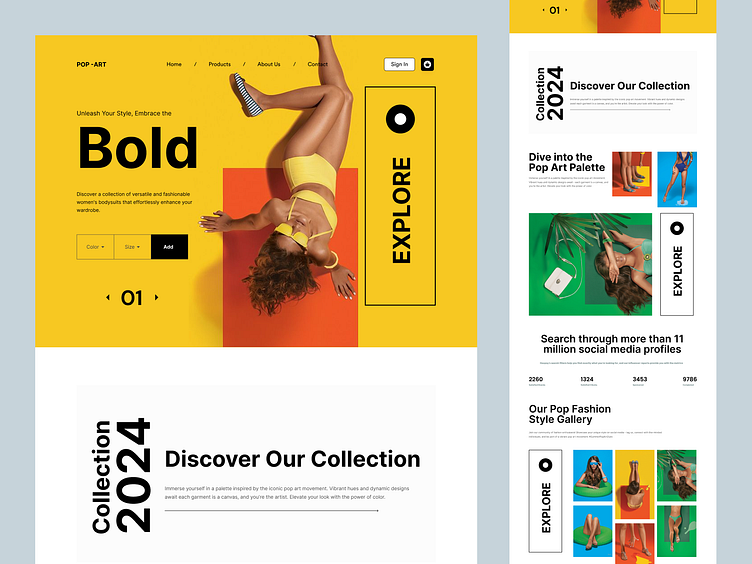
Pop art takes inspiration from mass culture, advertising, comics, consumer products, celebrities, and familiar visual symbols.
When adapted to website design, pop art can create an energetic and highly recognizable visual identity.
Bright colors, comic-style graphics, bold typography, repeated patterns, speech bubbles, and playful illustrations can give a website a strong personality.
This style is particularly useful for businesses that want to appear:
- Young
- Energetic
- Playful
- Creative
- Approachable
For example, a fashion, entertainment, food, or lifestyle brand could use pop-art-inspired design to make its website feel more memorable.
The key is consistency. Every visual element should contribute to the same brand identity.
4. Surrealist Website Design

Surrealism explores the imagination, dreams, and the subconscious mind.
In website design, this can translate into unexpected combinations, unusual imagery, distorted objects, dreamlike compositions, and interactive experiences.
Instead of presenting information in an entirely predictable way, surrealist design encourages visitors to explore.
Imagine a website where a product appears to float through space, where an ordinary object becomes enormous, or where different elements interact in unexpected ways.
This type of design can be especially effective for:
- Creative businesses
- Art organizations
- Fashion brands
- Advertising agencies
- Entertainment companies
- Experimental startups
However, creativity should never destroy usability. A visually fascinating website still needs clear navigation and understandable content.
5. Impressionist-Inspired Design

Impressionism is strongly associated with light, atmosphere, movement, color, and the way a scene feels at a particular moment.
A website inspired by impressionism can use soft gradients, atmospheric backgrounds, subtle textures, layered imagery, and gentle transitions.
Rather than presenting everything with sharp edges and rigid structures, the design can create a feeling of movement and emotion.
This approach can work well for brands connected with:
- Travel
- Hospitality
- Photography
- Luxury
- Wellness
- Lifestyle
- Art and culture
The objective is to make visitors feel something, not simply read something.
6. Cubism-Inspired Website Design

Cubism transformed traditional visual composition by breaking objects into geometric shapes and multiple perspectives.
The same concept can create an interesting approach to modern website design.
Instead of using a conventional grid, designers can experiment with:
- Squares
- Rectangles
- Triangles
- Overlapping images
- Asymmetrical layouts
- Geometric typography
- Fragmented visual elements
A cubism-inspired website can make a brand look modern, intellectual, experimental, and creative.
This style can be particularly effective for architecture, technology, design, fashion, and creative industries.
7. Photorealistic Website Design
Sometimes the most effective design is one that makes visitors feel like they are already experiencing the product.
Photorealistic website design focuses on high-quality photography and realistic visual presentation.
For an e-commerce business, for example, professional product photography can communicate details that text alone cannot.
A restaurant can use high-quality food photography. A hotel can showcase its rooms and facilities. A real-estate company can present properties through professional photography and virtual experiences.
Photorealism is especially powerful because it reduces the gap between the website and the real-world product.
The principle is simple:
Show people what they can expect.
High-quality images, realistic product presentations, and carefully selected photography can significantly strengthen the credibility of a website.
8. Digital Art Website Design

Digital art gives designers almost unlimited creative possibilities.
Through illustration, 3D graphics, animation, motion design, generative visuals, and interactive elements, businesses can create websites that feel completely unique.
Digital-art-inspired websites can combine:
- 3D objects
- Animated illustrations
- Motion graphics
- Interactive backgrounds
- Creative typography
- Abstract digital compositions
- Micro-interactions
This approach can be particularly effective for technology companies, creative agencies, gaming businesses, software companies, and innovative startups.
However, digital effects should support the user experience rather than slow down the website or distract visitors from important information.
9. Editorial & Magazine-Style Design

Another powerful source of inspiration comes from magazine and editorial design.
Editorial websites use strong typography, structured layouts, large headlines, carefully selected images, columns, pull quotes, and visual hierarchy to guide the reader through information.
This approach works particularly well for:
- Blogs
- News websites
- Publishing companies
- Personal brands
- Consulting businesses
- Marketing agencies
An editorial design can make even complex information feel organized and professional.
For content-driven businesses, this can also create a strong connection between design, storytelling, and SEO.
10. Interactive & Motion-Based Website Design

Modern websites can go beyond static pages.
Interactive design uses animation, scrolling effects, hover interactions, transitions, video, and other dynamic elements to create an engaging experience.
For example, a visitor might scroll down a page and see a product gradually appear, an illustration transform, or a statistic animate into view.
When used correctly, motion can:
- Guide attention
- Explain complex ideas
- Make products more memorable
- Increase engagement
- Strengthen brand personality
But there is an important rule:
Animation should have a purpose.
A website does not become better simply because it contains more effects. Every interaction should improve communication or user experience.
How to Choose the Right Website Design Style for Your Business
There is no single website design style that works for every company.
The right choice depends on your brand identity, target audience, industry, products, business objectives, and customer journey.
Before choosing a visual style, ask yourself:
Who is my target audience?
A playful pop-art website might work perfectly for a young lifestyle brand but may not be appropriate for a financial institution.
What should my brand communicate?
Do you want to communicate professionalism, creativity, luxury, innovation, trust, simplicity, or energy?
Your design should reinforce that message.
What action should visitors take?
A beautiful website is not enough. Visitors should know what to do next.
Whether the goal is to:
- Contact your business
- Request a quote
- Purchase a product
- Book a service
- Subscribe to a newsletter
- Download information
your design should make that action easy.
Great Website Design Is More Than Appearance
One of the biggest mistakes businesses make is thinking that website design is only about how a website looks.
A successful website combines design, content, usability, branding, SEO, performance, and conversion strategy.
Your website needs to look professional—but it also needs to be discoverable in search engines, load quickly, work on mobile devices, communicate your value clearly, and guide visitors toward taking action.
That is where strategy becomes just as important as creativity.
Build a Website That Represents Your Business
Your website is often the first interaction a potential customer has with your business.
That first impression matters.
Whether you choose minimalist design, abstract expressionism, pop art, surrealism, impressionism, cubism, photorealism, digital art, editorial design, or interactive design, the most important thing is to create a website that looks like your brand and speaks to your audience.
At Market Through, we believe website design should not simply make a business look good. It should help businesses be discovered, build credibility, connect with customers, and grow.
If your current website does not represent the quality of your business, it may be time for a change.
Your website is your digital identity. Make it count.
Looking for a website that represents your business?
Explore what Market Through can help you achieve with strategic website design, digital marketing, content, SEO, and brand-focused online experiences.
